



Is Your Air Quality Safe for Your Health?
Concerned about the air you breathe at home or work in Lompoc, CA? You are not alone, as indoor air quality can significantly affect your well-being, often harboring invisible contaminants that impact respiratory health and comfort. If you suspect your environment is compromising your health, contact us or call our office today to schedule a comprehensive assessment.
We provide a scientific approach to analyzing your indoor environment at Organ & Sons Mechanical, Inc. Many homeowners and facility managers do not realize that indoor air can be two to five times more polluted than outdoor air. Our service eliminates the guesswork by identifying exactly what is circulating through your ventilation system and living spaces.
- Real-time and historical air quality data to guide your environmental decisions.
- Expert testing for a wide range of pollutants, including VOCs, mold, and allergens.
- Practical advice and solutions to improve your indoor air quality for long-term health.
Certified by leading health and safety organizations to ensure accurate, reliable results.
What You Can Expect from Our Air Quality Testing Service
When you engage Organ & Sons Mechanical, Inc. for air quality testing, you are investing in a forensic analysis of your indoor environment. We do not simply walk in and sniff the air; we utilize advanced, calibrated diagnostic equipment designed to detect contaminants that are invisible to the naked eye. The goal is to provide you with actionable data that separates minor annoyances from serious health hazards.
Our service focuses on identifying a broad spectrum of airborne issues. This includes particulate matter (PM2.5 and PM10), which consists of microscopic solids or liquid droplets that can be inhaled deep into the lungs. We also screen for Volatile Organic Compounds (VOCs), which are gases emitted from certain solids or liquids found in common household products like paints, cleaning supplies, and building materials.
You can expect a thorough evaluation of biological pollutants as well. This includes testing for mold spores, pollen, pet dander, and dust mites. We assess carbon monoxide and carbon dioxide levels to ensure your ventilation system is effectively exchanging stale indoor air with fresh outdoor air. By covering these distinct categories, we provide a complete profile of your home’s respiratory safety.
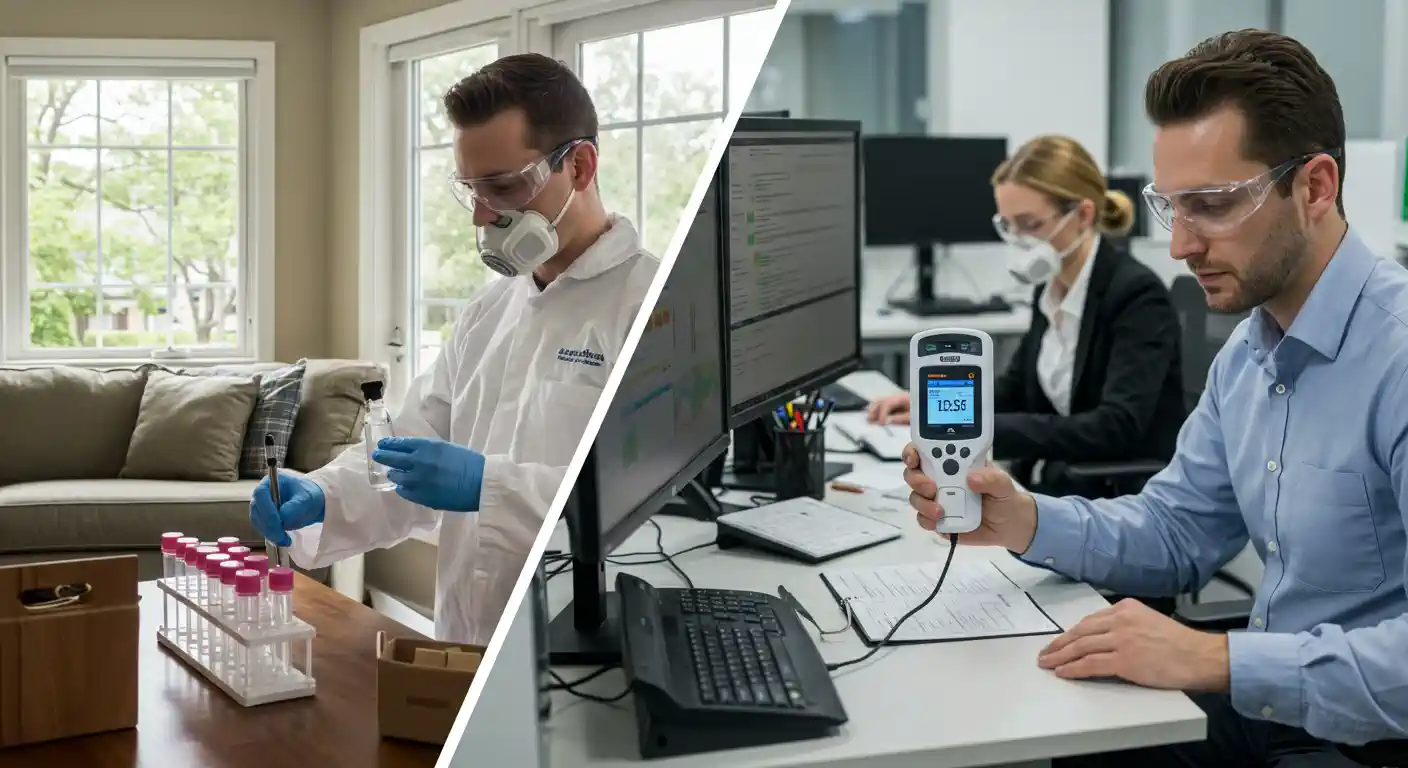
How Our Thorough Testing Process Works
We follow a strict, standardized protocol to ensure every test yields consistent and legally defensible data. We understand that accurate testing requires more than just setting up a monitor; it requires a strategic approach to sampling and inspection.
- Initial Visual Inspection: The process begins with a physical assessment of the property. We inspect the HVAC system, including filters, ductwork, and intake vents, looking for signs of moisture intrusion, visible mold growth, or excessive dust buildup. We also identify potential pollutant sources such as recent renovations, new furniture, or chemical storage areas.
- Baseline Data Collection: Before specialized sampling begins, we measure temperature and relative humidity. These environmental factors are critical because high humidity often correlates with mold growth, while low humidity can increase dust and virus transmission. Establishing this baseline helps us interpret the chemical and biological data later.
- Active Air Sampling: We utilize air pumps and impactors to collect air samples from multiple zones within the building. This includes "high-traffic" living areas and sleeping quarters. Simultaneously, we collect an outdoor control sample. Comparing indoor results against the outdoor baseline is essential to determine if the pollutants are originating from inside the house or entering from the outside environment.
- Surface Sampling (If Necessary): If visual inspection reveals suspicious staining or debris, we perform tape lift or swab samples to identify specific fungal genus or particle types. This is particularly relevant for verifying mold presence versus simple dust accumulation.
- Lab Analysis and Reporting: Samples are analyzed to determine the concentration and type of contaminants. We compile these findings into a detailed report that highlights any levels exceeding health guidelines.
- Consultation and Strategy: Finally, we review the report with you. We do not just hand over a complex data sheet; we explain what the numbers mean and outline specific mechanical or structural changes required to rectify the issues.
When It's Critical to Test Your Indoor Air Quality
While routine testing is a good preventative measure, certain life events and environmental triggers make air quality testing a necessity rather than a luxury. Acting quickly when these signs appear can prevent long-term health issues and costly remediation bills down the road.
- Real Estate Transactions: Buying a home in Lompoc is a significant investment. Standard home inspections rarely cover detailed air quality analysis. If the home has been closed up for a long period or has a history of water damage, testing is crucial before closing. It ensures you are not inheriting a "sick building" with hidden mold issues or ventilation deficiencies.
- Unexplained Health Symptoms: If occupants experience allergies, headaches, fatigue, or respiratory irritation that improves when they leave the building, the building itself is likely the culprit. This phenomenon, often called Sick Building Syndrome, indicates high levels of VOCs or biological contaminants. Testing identifies the specific allergen or toxin causing the reaction.
- Post-Renovation or Remodeling: Construction projects release massive amounts of dust, fiberglass, and chemical off-gassing from new flooring, paint, and adhesives. Even with containment measures, debris often infiltrates the HVAC system. Testing after a renovation ensures that the air has returned to safe levels and that construction byproducts are not recirculating.
- Visible Moisture or Musty Odors: Water is the enemy of indoor air quality. If you have experienced a plumbing leak, roof leak, or flood, biological growth can begin within 24 to 48 hours. Even if the water is cleaned up, moisture trapped in walls or carpets can fuel mold growth. A persistent musty smell is a definitive signal that testing is required to locate the source and extent of the contamination.
- HVAC System Upgrades: Before installing a new heating or cooling system, it is wise to test the current air quality. This establishes a baseline and helps determine if you need additional filtration, humidification, or dehumidification integrated into the new system. It ensures your new equipment is sized and configured to address specific air quality challenges.
Understanding Local Air Quality Issues and Seasonal Impacts
Air quality is not just about what is happening inside your walls; it is deeply influenced by the regional climate and external environment. In Lompoc, the specific Mediterranean climate presents unique challenges that homeowners must manage to maintain healthy indoor air.
The "June Gloom" and Moisture Management
The region is known for persistent coastal fog in late spring and early summer, locally referred to as "June Gloom." While this keeps temperatures mild, it brings sustained high humidity. If your home lacks proper ventilation or if your HVAC system is not sized correctly to dehumidify, this external moisture can migrate indoors. High indoor humidity creates the perfect breeding ground for mold and dust mites. During these months, air quality testing often reveals elevated spore counts even in homes without direct water leaks.
Wildfire Season and Particulate Matter
Like much of California, the Central Coast is susceptible to wildfire smoke, which can travel hundreds of miles. During fire season, indoor air quality can plummet as fine particulate matter (PM2.5) infiltrates through gaps in doors, windows, and attic spaces. Testing during or after fire season can determine if smoke damage has occurred within your ductwork or on porous surfaces in the home, necessitating specialized cleaning.
Dry Summers and Dust
Conversely, the dry summer months from June to August often result in increased dust and pollen intrusion. The lack of rainfall allows allergens to remain airborne longer. Homes with older windows or poor sealing often see spikes in particulate matter during these months. Understanding these seasonal shifts allows us to recommend solutions that are adaptable—such as whole-home dehumidifiers for the spring and high-efficiency filtration for the dry, dusty summer.
Interpreting Results: Solutions for Improvement
Once the testing is complete, the focus shifts to resolution. The data we provide dictates whether the solution involves simple maintenance or significant equipment upgrades. We help you distinguish between scenarios that require cleaning versus those that require mechanical intervention.
- Source Removal: If testing identifies a specific source of VOCs, such as old paint cans or chemical cleaners, the immediate solution is removal. If mold is found, remediation of the affected material is the priority before any air purification takes place.
- Ventilation Improvements: High CO2 levels often indicate that the home is "too tight" and not getting enough fresh air. The solution here is often the installation of an Energy Recovery Ventilator (ERV) or Heat Recovery Ventilator (HRV) to bring in fresh outdoor air while exhausting stale indoor air without losing thermal energy.
- Filtration Upgrades: If high levels of dust, pollen, or PM2.5 are detected, standard 1-inch furnace filters are usually insufficient. We may recommend upgrading to media cabinets with MERV 11 or MERV 13 ratings, or installing electronic air cleaners that capture smaller particles.
- Humidity Control: If the data shows humidity constantly hovering above 60% (common during fog season) or below 30%, we recommend installing whole-home dehumidifiers or humidifiers. Controlling humidity is the single most effective way to inhibit biological growth.
- Air Purification: For issues related to viruses, bacteria, or odors that filtration cannot catch, UV germicidal lights or oxidizing air purifiers may be recommended to neutralize contaminants at the molecular level within the ductwork.
Why Choose Us: Certifications and Local Expertise
Selecting the right partner for air quality testing is a decision that directly impacts the health of your family or employees. You need a partner who understands building science, mechanical systems, and the specific environmental conditions of the Central Coast.
- Calibrated, Professional Equipment: We do not rely on consumer-grade monitors found at hardware stores, which often provide inaccurate or fluctuating readings. Our equipment is professionally calibrated and designed for industrial and residential auditing. This ensures that the data we provide is accurate enough to base major renovation or medical decisions upon.
- Unbiased, Data-Driven Reporting: Our primary goal is to provide you with the truth about your indoor environment. We interpret the lab results based on established health standards, not sales targets. When we recommend a solution, it is because the data supports it. If your air quality is good, we will tell you. If it requires attention, we provide a clear, prioritized list of steps based on severity.
- Deep Understanding of Mechanical Systems: Air quality is inextricably linked to your HVAC system. Unlike general environmental consultants who may not understand airflow dynamics, we approach testing with a deep knowledge of how heating and cooling systems distribute air. We can identify if a problem is caused by leaky ductwork, oversized equipment, or blocked intakes—issues that standalone testing companies might miss.
- Local Experience: We have extensive experience working with the specific housing stock found in this region, from historic properties with older insulation to modern, airtight construction. We understand how the local climate interacts with these structures to create specific air quality profiles. Organ & Sons Mechanical, Inc. leverages this local knowledge to provide context to your test results, ensuring that our recommendations are practical and effective for your specific location.
Your health is too important to leave to chance. If you are experiencing symptoms, planning a renovation, or simply want the peace of mind that comes with knowing your home is safe, take action today. Secure a detailed analysis of your indoor environment and breathe easier knowing exactly what is in your air.
Testing Services That Deliver Clear Insight
Accurate air quality testing in Lompoc, CA, provides valuable insight into indoor air conditions and system performance. Organ & Sons Mechanical, Inc. conducts detailed testing to identify pollutants and airflow concerns affecting indoor environments. Without testing, air quality issues often go undetected. Our evaluations support informed decisions and targeted improvements.
Gain clarity on indoor air conditions through professional testing services.
Request Professional Air Quality Testing Today
Contact Us