



AC Service in Salinas, CA
Facing AC issues in Salinas? Schedule a rapid, professional diagnostic and repair. Immediate appointments available. Ensure your home comfort today!
Is Your Air Conditioner Blowing Warm Air?
When you turn on your cooling system during a warm afternoon in Salinas, you expect immediate relief, not a blast of warm air or a system that refuses to cycle on. If your system is failing to keep your home comfortable, contact us immediately to schedule a diagnostic visit.
Homeowners in the Salinas Valley know that while our climate is generally mild, the warm spikes in late summer and early autumn can make a functional air conditioner a necessity rather than a luxury. When a breakdown occurs, you need a solution that addresses the root cause of the mechanical failure, not just a quick patch. Organ & Sons Mechanical, Inc. provides comprehensive diagnostics and repair services designed to restore your system's efficiency and cooling capacity the same day you call.
- Rapid Response Times: We prioritize dispatching certified technicians to diagnose your system immediately, minimizing downtime.
- Upfront, Flat-Rate Pricing: You receive a clear quote for the necessary repairs before any work begins, eliminating surprise costs.
- Technical Accuracy: Our team uses advanced diagnostic tools to pinpoint electrical and mechanical faults accurately.
All repair and service work is fully licensed, insured, and backed by a labor warranty to guarantee your system operates correctly.
Comprehensive AC Diagnostics and Repair Scope
When you book a service appointment, the goal is to identify exactly why the thermodynamic cycle of your air conditioner has been interrupted. Modern cooling systems are complex machines involving high-voltage electricity, pressurized refrigerant, and airflow dynamics. A proper service visit goes beyond a visual inspection; it involves testing the system under load to ensure it meets manufacturer specifications.
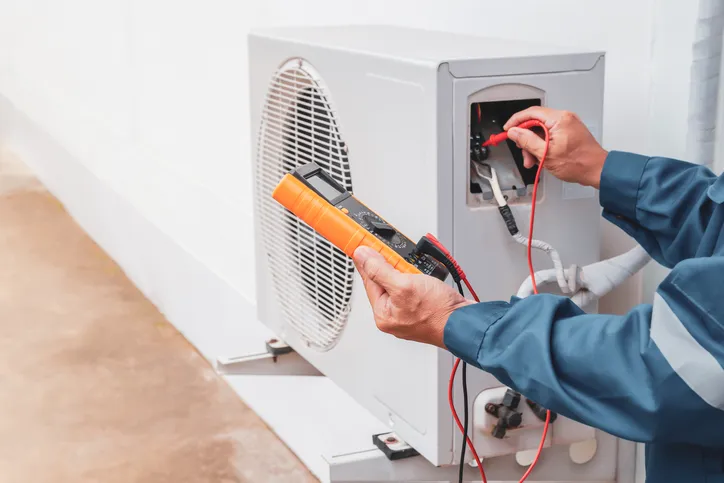
Electrical Component Failure Analysis
The most common reason for a sudden AC failure is an electrical issue. Over time, vibration and thermal fluctuations cause connections to loosen and components to degrade. During a service visit, technicians inspect the entire electrical circuit.
- Capacitor Testing: Start and run capacitors store energy to power the compressor and fans. If these fall below their microfarad rating, the system may hum but fail to start.
- Contactor Inspection: The contactor acts as the switch for the outdoor unit. Pitted or burnt contacts can prevent the voltage from reaching the compressor, leading to system failure.
- Wiring and Connections: Loose wires can cause arcing or overheating. Technicians tighten all control voltage and high voltage connections to prevent future shorts.
Refrigerant Leak Detection and Recharging
If your system is running but the air coming from the vents is lukewarm, it often indicates a refrigerant issue. An air conditioner does not consume refrigerant like a car consumes gas; a low level indicates a leak that must be located.
- Pressure Tests: Gauges are attached to the service ports to measure subcooling and superheat levels, determining if the refrigerant charge is correct.
- Leak Search: Technicians use electronic sniffers or UV dye to locate the source of the leak, whether it is in the evaporator coil, condenser coil, or line set.
- Recharging: Once a leak is repaired, the system is recharged to the factory-specified weight to ensure optimal cooling capacity.
Airflow and Mechanical Optimization
Even with a perfect charge and good electrical components, an AC unit cannot cool your home if airflow is restricted.
- Coil Cleaning: The outdoor condenser coil releases heat. If it is clogged with dirt, pollen, or debris common in the Salinas area, the system overheats and shuts down. Chemical cleaning restores heat transfer.
- Blower Motor Assessment: The indoor blower moves air through the ducts. Technicians check the amperage draw and wheel balance to ensure it is moving the correct volume of air (CFM).
- Drain Line Clearing: The cooling process creates condensation. If the condensate drain line is clogged with algae or sediment, it can trigger a safety float switch that shuts off the entire unit to prevent water damage.
How the Service and Repair Process Works
Restoring your home’s comfort should be a structured, transparent process. Professional service providers follow a strict protocol to ensure safety and quality control from the moment the truck arrives at your property.
- Arrival and Site Protection: The technician arrives within the scheduled window, fully equipped with a stocked service vehicle. Shoe covers and drop cloths are used to protect your flooring and workspace before any tools are brought inside.
- System Diagnostics: The technician performs a complete system evaluation. This includes checking the thermostat, furnace or air handler, and the outdoor condensing unit. This holistic approach ensures that a symptom in one area isn't caused by a failure in another.
- Presentation of Findings: You are presented with a detailed report of what is broken, why it failed, and the condition of the rest of the system. This allows you to make an educated decision.
- Quoting and Approval: A flat-rate price is provided for the repair. This price includes all parts, labor, and taxes. Work only begins after you have authorized this quote.
- Execution of Repair: The technician performs the repair using OEM or high-quality aftermarket parts. This may involve replacing a motor, welding a refrigerant line, or replacing a circuit board.
- Performance Testing: After the repair is complete, the system is run through a full cycle. The technician measures the temperature split (the difference between air entering and leaving the system) to verify cooling performance.
- Final Walkthrough: The technician explains the work performed, demonstrates that the system is cooling, and provides tips for maintaining the repair.
Deciding Between Repair and Replacement
Homeowners often face a difficult choice when an older unit breaks down: is it worth fixing, or is it time to invest in a new system? While Organ & Sons Mechanical, Inc. is fully equipped to repair most issues, there are mathematical and practical threshold points where replacement becomes the more financially sound option.
The "50% Rule"
A common industry standard for decision-making is the 50% rule. If the cost of the repair approaches 50% of the value of a new system, replacement is generally the better investment. This is particularly true because a new system comes with a fresh warranty, whereas a repair only guarantees the specific part that was fixed.
Age and Refrigerant Type
The age of your unit is a critical factor. The average lifespan of a central air conditioner is 10 to 15 years.
- Units Over 10 Years Old: If your system is over a decade old and requires a major component like a compressor or coil, the repair costs rarely justify the extended life you will get from the unit.
- R-22 vs. R-410A: Older systems utilize R-22 (Freon), which has been phased out. R-22 is becoming prohibitively expensive and difficult to source. If your R-22 system has a refrigerant leak, upgrading to a modern system that uses R-410A or newer refrigerants is usually the only viable long-term solution.
Energy Efficiency Considerations
AC technology has advanced significantly in the last decade. Older units often have a Seasonal Energy Efficiency Ratio (SEER) of 10 or 12.
- SEER2 Standards: Modern units meet new SEER2 standards, often starting at 14.3 or higher.
- Monthly Savings: Replacing a 10 SEER unit with a 16 SEER unit can reduce cooling costs by nearly 40%. If your energy bills in Salinas have been creeping up despite moderate usage, the inefficiency of an aging unit is likely the culprit.
- Comfort Features: Newer systems often feature two-stage or variable-speed compressors. Unlike single-stage units that blast at 100% capacity and then shut off, these systems run at lower speeds to maintain a constant temperature and remove more humidity.
Local Considerations: Permits, Utilities, and Climate
Operating an air conditioner in Salinas requires specific attention to local regulations and environmental factors. Ignoring these can lead to compliance issues or premature system failure.
Permitting and Code Compliance
Any significant HVAC work, particularly system replacements or major modifications, requires a permit from the City of Salinas Building Division.
- Safety Inspections: Permits ensure that a third-party inspector verifies the safety of the installation, checking gas lines, electrical connections, and venting.
- Resale Value: Unpermitted work can complicate the sale of a home. Buyers frequently ask for proof that mechanical upgrades were performed to code.
- Title 24 Compliance: California's energy code (Title 24) is strict. It requires specific duct sealing and airflow testing. Professional service providers handle the HERS testing and documentation required to close out these permits.
Coastal Climate Impacts
Salinas has a Mediterranean climate with a coastal influence. While it is not directly on the beach, the marine layer and salt air can still reach inland properties.
- Corrosion Risks: Aluminum fins and copper tubing in the outdoor condenser are susceptible to corrosion from salt and moisture. This can lead to "fin rot," where the fins crumble and reduce heat transfer.
- Seasonality: The cooling season in Salinas is concentrated. Systems often sit idle for months during the wet winter and mild spring. This dormancy can cause seals to dry out or pests to nest in the unit. Pre-season maintenance in late spring is vital to ensure the unit is ready for the August and September heat spikes.
Utility Rebates
Local utility providers often offer rebates for upgrading to high-efficiency equipment. These programs change annually but typically incentivize the installation of high-SEER heat pumps or air conditioners. Professional contractors stay updated on these programs and can help homeowners identify available financial incentives to offset the cost of a new installation.
Technical Expertise and Service Standards
The difference between a lasting repair and a recurring problem often lies in the expertise of the technician performing the work. Selecting a service provider should be based on technical capability and operational standards.
- Certified Technicians: Modern HVAC equipment involves proprietary control boards and inverter-driven compressors. Technicians must undergo continuous training to diagnose these systems without resorting to trial-and-error parts changing.
- Proper Tooling: Correctly servicing an AC requires specific tools, including micron gauges for vacuuming lines, combustion analyzers for safety checks (on gas packs), and psychrometers for measuring air properties.
- Inventory Management: A fully stocked truck means that common parts—contactors, capacitors, hard start kits, and universal motors—are available immediately. This reduces the need for second trips and gets your system running faster.
- Respect for Property: Service extends beyond the machine. It involves treating the home with respect, using drop cloths, and removing all debris and old parts upon completion of the job.
Maintaining a cool and comfortable home requires a mechanical partner who understands both the equipment and the local environment. Whether you are facing an emergency breakdown or planning a proactive system replacement, professional intervention ensures efficiency and safety.
Don't let a failing air conditioner compromise your comfort this season—schedule your comprehensive service visit today.
Structured Care That Maintains System Stability
Routine AC service in Salinas, CA, supports consistent operation and helps reduce unexpected disruptions. Organ & Sons Mechanical, Inc. performs detailed service evaluations to identify wear, airflow concerns, and performance drift. Skipped service often increases repair frequency. Our approach supports predictable system operation.
Maintain steady AC performance through professional service tailored to your system.
Schedule Professional AC Service Support
Contact Us